If your business already has a Facebook page, it is fair to ask whether you really need a website too. Your customers are on Facebook, your page took time to build, and a website is one more thing to pay for and look after.
The short answer: keep the Facebook page, and add a website. They do different jobs. A page is good for conversations with people who already know you. A website is how strangers find you, check you out and decide to get in touch. This guide explains why, using real numbers on how Filipinos use the internet, and what to do if you are only able to start with one.
Why so many owners start with Facebook
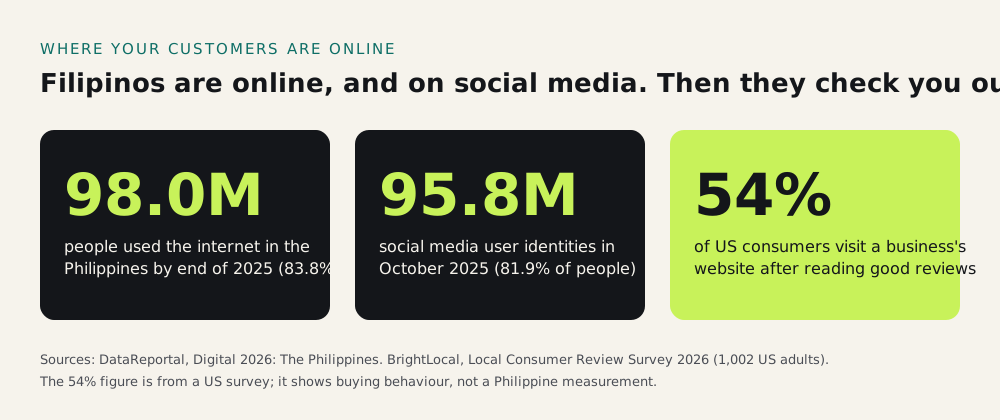
Starting on Facebook makes sense in the Philippines. According to DataReportal’s Digital 2026: The Philippines report, about 98.0 million people in the Philippines were using the internet at the end of 2025, which is 83.8% of the population. There were 95.8 million social media user identities in October 2025, and 97.7% of all internet users used at least one social platform. Facebook’s advertising reach alone was equal to about 81.9% of the whole population.
A Facebook page is free, quick to set up and sits where your customers already are. For a new business it is a good place to begin. The question is what happens when someone wants to know more about you.
What a Facebook page does well
- Conversations. Customers can message you, comment and react. That friendliness is valuable.
- Keeping regulars up to date. People who already follow you see your news, offers and photos.
- It costs nothing to start. You can be online within the hour.
- Social proof. Followers, comments and tagged photos show that real people deal with you.
Nothing here argues against Facebook. The point is what a page cannot do on its own.
What a Facebook page cannot do
1. You do not own it. Your page lives on someone else’s platform. Meta decides the layout, the features and the rules. It can change how pages work, reduce how many followers see your posts, or restrict a page, and you have little say in any of it. A website, by contrast, is yours: your address, your design, your content.
2. It is hard to find on Google. Search engines can show Facebook pages, but you have little control over how your page appears in results, and a page is rarely the best answer to a search like “dentist in Alabang”. A website built for search can be written and structured to match what people actually type.
3. AI tools rely on websites. More people now ask tools such as ChatGPT, Gemini and Perplexity for recommendations. These tools answer by reading information on the open web. A clear website that states who you are, where you work, what you offer and what it costs gives them something to read and cite. A social page often gives them very little.
4. It limits how professional you look. A page can look the same as every other page on the platform. A website with your own web address, your own design and your prices and answers in one place says that you are an established business.
5. It is built for scrolling, not for deciding. Information on Facebook is spread across posts, photos, a short About section and comments. A website puts your services, prices, hours, location and a clear way to contact you where a visitor can find them in seconds.
What customers do before they choose you
Customers rarely go from a post straight to buying. They check you out first. BrightLocal’s Local Consumer Review Survey 2026, which surveyed 1,002 adults in the United States, found that 54% of consumers visit a business’s website after reading positive reviews, up from 32% when the question was last asked in 2019. Another 24% visit the business’s social media channels. The same report notes that only about 40% of local businesses have a dedicated website, so many customers who want to look you up end up with nothing to find.
That survey is American, so it is not a measurement of Filipino shoppers. We include it because it shows a pattern that holds for most buying decisions: people look for a website after something first catches their attention. If they cannot find one, some of them will quietly go elsewhere.
A simple way to think about it: rent and own
A useful picture is renting against owning.
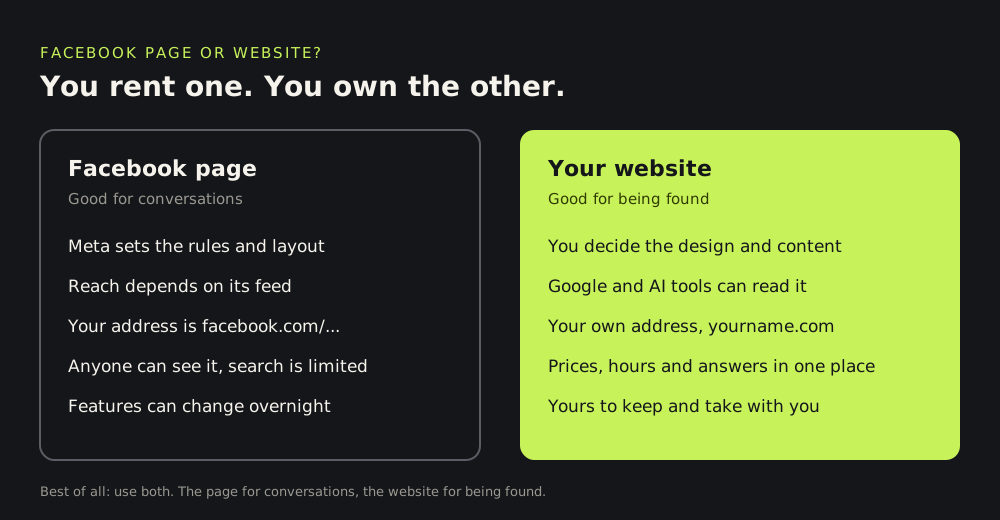
- A Facebook page is rented space. It is quick and cheap, and it works as long as the platform’s rules and features suit you.
- A website is a property you own. It takes a little more to set up, but it is yours to shape, move and keep.
Most smart businesses do both. The Facebook page is for conversations. The website is for being found, for trust and for the details that help someone decide.
Facebook page or website: a quick comparison
| Facebook page | Your own website | |
|---|---|---|
| Cost to start | Free | Set-up fee, then a monthly or yearly cost |
| Who controls it | Meta | You |
| Your web address | facebook.com/yourpage | yourbusiness.com |
| Found on Google by what you offer | Limited | Built for it |
| Easy for AI tools to read and cite | Limited | Yes, when written clearly |
| Prices, hours and answers in one place | Spread across posts | Yes |
| Best for | Conversations and regulars | Being found and trusted |
When a Facebook page alone can be enough
We are not going to tell you everyone needs a website tomorrow. A page alone can be enough if:
- You sell only to people who already follow you, such as a small circle of regulars.
- Your business is very new and you are still testing the idea.
- You do not need new customers right now.
Even then, the moment you want customers you do not already know to find you, a website starts to matter.
What your website should include
A small business website does not need to be big. For most owners it should have:
- A clear headline saying what you do and where, such as “Home bakery in Alabang”.
- Your services or products with prices where you can share them.
- Your location, area and opening hours.
- One obvious way to contact you, such as a Viber or phone number.
- Real photos and short answers to the questions customers always ask.
- A mobile-friendly design, since most customers will open it on a phone.
- Links to your Facebook and Instagram, so the pages and the site support each other.
How to use both together
- Put your website address on your Facebook page in the About section and in the button at the top.
- Link your page from your website, so visitors can follow you.
- Keep your business name, phone number and area the same on both, and on your Google Business Profile.
- Share new posts and offers on Facebook, and keep the permanent information on your site.
- Ask happy customers for a Google review. Reviews help people find and trust you.
What a website costs and how long it takes
It depends on who builds it. Our guide to website costs in the Philippines explains typical price ranges and what to ask for in a quote.
For reference, we build websites on a monthly plan, with a ₱4,999 one-time set-up fee and plans from ₱1,999 a month. We work from your Facebook page if that is all you have, so you do not need to prepare anything. Most sites go live in about 3 days, and we design a free preview of your homepage first. You only pay if you love it. See the full details on our pricing page.
Next steps
If you have a Facebook page and want a website that helps customers find you on Google and in AI search, message us on Viber with your business name. We will take it from there. You can also read our FAQ or see the sites we have built.
Sources
- DataReportal, Digital 2026: The Philippines: internet users, social media user identities and Facebook reach.
- BrightLocal, Local Consumer Review Survey 2026: website visits after reviews, social channel visits and local business website ownership (a survey of 1,002 US adults).
Written by Alec and Andy. Statistics are from the sources above and change over time.