If you run a small business in the Philippines and want a website, the first question is always the same: how much will it cost? The honest answer is that the price of a website in the Philippines ranges from a few thousand pesos to several hundred thousand, and the number on the quote often tells you less than what the quote leaves out.
This guide explains the typical price ranges for 2026, what makes one website cost more than another, the costs people forget, and how to compare a one-time build with a monthly plan. We are Twin Websites, programmer twins from Alabang, so we have a view on this, and we will tell you where our own pricing sits and where it does not.
The short answer
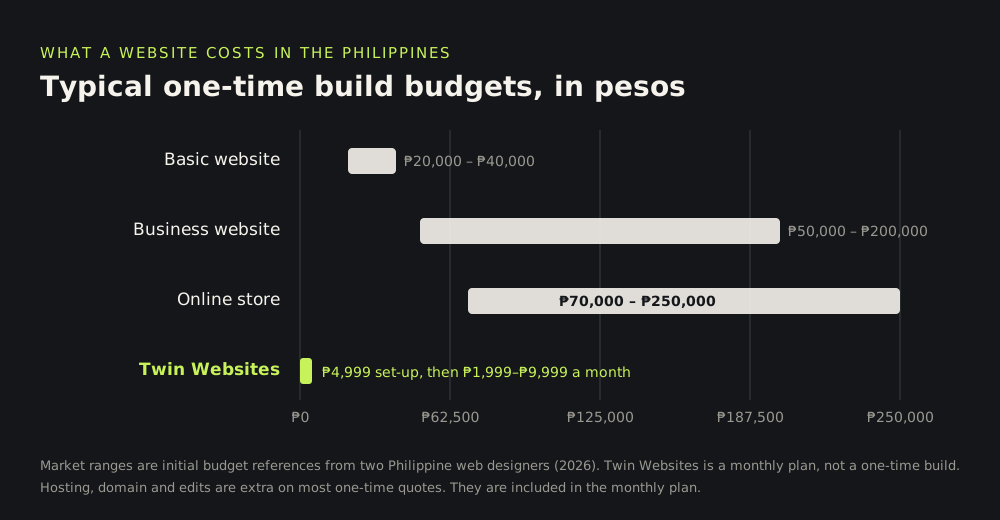
Philippine web designers who publish their prices give broadly similar reference ranges for a one-time build:
- A basic informational website: about ₱20,000 to ₱40,000.
- A business or corporate website: about ₱50,000 to ₱200,000.
- An online store: about ₱70,000 to ₱250,000 for a platform-based shop, and far more for a fully custom build.
These figures come from two Philippine providers’ 2026 pricing guides: Wazile’s website cost guide and Dixie Raiz Pacheco’s web design pricing page. Both describe them as starting references, not fixed prices. Another Philippine guide, Design Blue Manila’s honest breakdown, puts typical agency projects higher, in the ₱100,000 to ₱250,000 range.
Freelancers often quote less. Wazile’s guide notes that freelancers may start from around ₱5,000 to ₱20,000 for a basic site, while agencies charge more and offer more support. Those are one-time prices for the build. Almost everything that happens after launch is a separate cost, which is where the real total comes from.
Why website prices vary so much
Two websites that look similar on a phone can cost very different amounts. The price usually depends on five things.
1. Who builds it. A freelancer, a small studio and a large agency have very different overheads. Agencies pay for offices, account managers and sales teams, and that is built into the price. A small team of developers does not carry those costs.
2. How much is custom. A site built on a template with your logo and photos costs far less than one designed from a blank page. Custom animation, bespoke layouts and special features all add hours.
3. How many pages and features. A one-page site, a five-page business site and a shop with a hundred products are completely different jobs. Booking forms, payment gateways, member areas and live chat each add cost.
4. Who writes the words. Some quotes include copywriting. Others assume you will supply every word and photo, and charge extra if you do not. This is one of the biggest hidden differences between quotes.
5. What happens after launch. Hosting, security updates, backups, edits and fixes are sometimes included and sometimes billed separately by the hour.
The costs people forget
A quote for the build is rarely the whole story. Budget for these as well.
- A domain name. Your web address, such as yourbusiness.com, is renewed every year. Wazile’s guide gives a range of about ₱500 to ₱3,400 a year depending on the extension and provider.
- Hosting. The server that keeps your site online. The same guide lists shared hosting from roughly ₱160 to ₱900 a month for typical business sites, with more powerful options costing much more.
- Updates and security. Websites need their software updated and their security watched. If nobody does it, sites eventually break or get hacked.
- Edits. Changing a price, adding a photo or updating your opening hours. Some providers include small edits, others charge per request.
- Getting found. A website that nobody can find does little for the business. Search engine optimisation (SEO) and, for some businesses, Google Ads are separate work, often with a separate fee.
- Your time. Writing the content, choosing photos and replying to questions during the build takes hours. If you are doing it yourself on a website builder, that time is a real cost.
When you compare two quotes, ask for the first-year total: build, domain, hosting, edits and security. A cheap build with expensive extras can cost more than a higher-priced quote that includes everything.
One-time build or monthly plan?
There are two common ways to pay for a website.
A one-time build means you pay a larger sum up front, usually in two or three stages. You then own the finished site and look after hosting, updates and edits yourself or pay someone by the hour. This often makes sense for larger businesses with a clear brief and an in-house person to manage the site.
A monthly plan means a small set-up cost, followed by a fixed monthly fee that covers hosting, security, updates and small edits. You start for much less, and someone is always responsible for keeping the site working. The trade-off is that you keep paying, and over several years the total can approach or pass a one-time build.
Neither is better for everyone. The right one depends on your cash flow, how often your site changes and whether you want to manage it yourself.
How Twin Websites pricing compares
We work on a monthly plan. Every plan has the same ₱4,999 one-time set-up fee, followed by one of three monthly plans:
| Plan | Monthly | First-year total | Three-year total |
|---|---|---|---|
| Bronze | ₱1,999 | ₱28,987 | ₱76,963 |
| Silver | ₱4,999 | ₱64,987 | ₱184,963 |
| Gold | ₱9,999 | ₱124,987 | ₱364,963 |
These totals are simply the ₱4,999 set-up fee plus twelve (or thirty-six) months of the plan. The Gold plan includes running your Google Ads, but the ad budget itself is separate, and you choose it.
Here is how that compares, without spin:
- In the first year, Bronze at ₱28,987 sits in the same range as a basic one-time site of ₱20,000 to ₱40,000. The difference is what is included: hosting, security, backups and small edits are covered, where a one-time quote usually leaves them out.
- Over three years, a monthly plan can cost more than a one-time build. Bronze comes to about ₱77,000 over three years. We would rather say so than hide it. The upside is that you start small, you are not paying for a big build before you know it works, and you can buy your website outright whenever owning it makes more sense.
- You are never locked in. There is no long contract, and the site is yours. If you want to take it over, there is a one-time handover fee, which we confirm in writing before you decide.
Our set-up fee is 95% less than a typical agency quote, because we are two programmers with no office, no sales team and no account managers to pay for. We also build the site and show you a free preview of your homepage first. You only pay if you love it.
Red flags when comparing quotes
- A price with no list of what is included. Ask for the deliverables in writing: pages, edits, hosting, domain and training.
- Pressure to decide today. A good provider lets you compare.
- No mention of mobile. Most Filipino customers will see your site on a phone first. If mobile is not mentioned, ask.
- No plan for getting found. A beautiful site that Google cannot understand will not bring customers.
- You do not own the site. Check who owns the domain name and the design files. Some providers keep both, which makes leaving expensive.
- Everything is “unlimited”. Unlimited revisions or pages usually means limits hidden in the fine print.
Questions to ask before you pay
- What is the total I will pay in the first year, with everything included?
- Who owns the domain name and the finished website?
- Who writes the words and chooses the photos?
- What happens if I want small changes after launch, and what do they cost?
- How will my customers find the site on Google and in AI tools?
- What happens if I want to stop?
So, how much should you budget?
For a small local business, a sensible approach is:
- Decide what the site must do. For most small businesses it only needs to explain what you do, show prices or examples, and make it easy to message or call you.
- Ask two or three providers for the first-year total, in writing, on the same list of requirements.
- Match the payment model to your cash flow. If a large up-front payment is hard, a monthly plan lets you start sooner.
- Pick the provider who explains things clearly, not the cheapest or the most expensive.
If you want to see what your own site could look like before spending anything, message us on Viber with your business name. We will design a free preview of your homepage, and you only pay if you love it. You can also see all our plans and prices, read what each service includes or browse the questions we hear most.
Sources
- Wazile, How Much Does a Website Cost in the Philippines? (2026 Detailed Guide), updated August 2026: basic site, domain and hosting ranges.
- Dixie Raiz Pacheco, Web Design Philippines Pricing, 2026: basic, business and online store reference ranges.
- Design Blue Manila, How Much Does a Website Cost in the Philippines? An Honest Breakdown, 2026: typical agency project ranges.
- Twin Websites plan prices, from our pricing page. Totals are our own arithmetic from those prices.
Written by Alec and Andy. Prices from other providers are reference ranges and change over time, so always ask for a current written quote.